Tofino Hiking Trails Guide
Best hikes in Tofino: Rainforest Trail, Tonquin, Meares Big Tree, and Lone Cone. Easy boardwalks to challenging climbs - here’s how to plan.
Last updated: March 26, 2026
Keep the free and park walks as independent routes. The verified Meares Island option includes a private boat and Big Tree Trail; it does not climb Lone Cone.
Affiliate links: we may earn a commission from qualifying bookings.
Tofino Hiking Trails At A Glance
| Rainforest Trail (A + B) | 1.2 km each loop | Easy | 45-60 min per loop | Pacific Rim NPR; Parks Canada pass required ($10.00 adult/day) |
| Tonquin Trail | 3 km (+ 800 m boardwalk) | Easy–Moderate | 1-1.5 hrs one way | Free; walkable from downtown Tofino |
| Meares Island Big Tree Trail | 2.4 km (boardwalk out-and-back) | Easy | 1-1.5 hrs (boardwalk only) | Water taxi (~$30/person); trail fee $35 adult / $30 youth+senior / $25 child |
| South Beach Trail | 1.6 km (out-and-back) | Easy-Moderate | 30-45 min | Pacific Rim NPR; Parks Canada pass required |
| Nuu-chah-nulth Trail | 2.5-3.8 km (one-way connector) | Moderate | 1-2 hrs | Pacific Rim NPR; Parks Canada pass required |
| Lone Cone Trail | 2.7 km one-way (5.4 km return) | Challenging | 5-7 hrs round trip | Water taxi to Meares Island; book via Ahous Adventures |
Parks Canada day pass: Adult $10.00, Senior $8.40, Youth free, Family/Group $20.00. Annual adult pass $50.08. Verified March 2026.
What Are The Best Hiking Trails In Tofino?
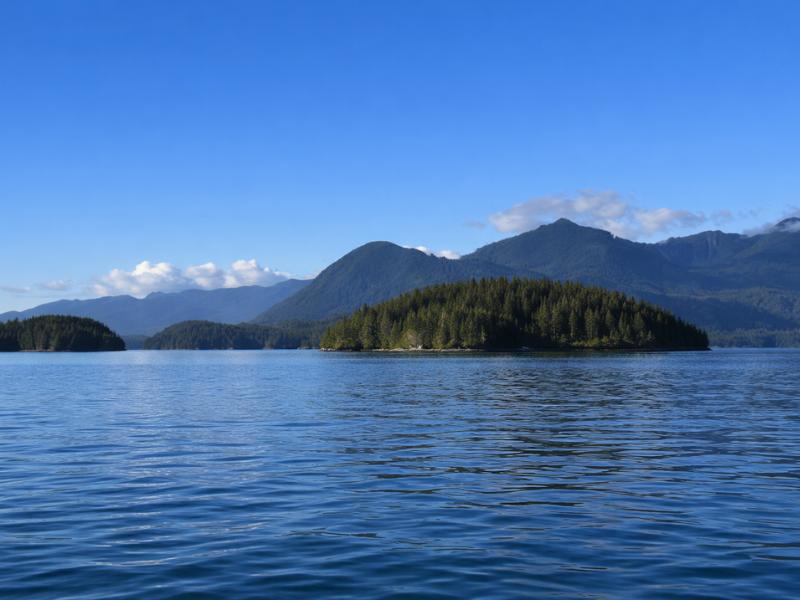
The best hiking near Tofino ranges from a 45-minute stroll through old-growth cedar on a boardwalk to a gruelling 700-metre ascent on Meares Island that takes a full day. The Rainforest Trail is the most accessible for all ages. The Tonquin Trail is the closest to town. The Big Tree Trail on Meares Island has the most extraordinary individual trees. The South Beach and Nuu-chah-nulth Trails connect coastal forest and beaches in one route. Lone Cone rewards fit hikers with the best elevated view in the region.
Most visitors to Tofino know it as a surf town. What takes longer to understand is that the rainforest behind every beach is one of the finest temperate old-growth ecosystems remaining on the planet. Trees here are 1,400 years old. Western red cedars grow to 18 metres in circumference. The forest floor is a continuous mat of moss and fern under a canopy that reduces midday light to something green and filtered. The hiking trails in and around Tofino exist to let you move through that environment slowly, without the sound of the highway, without the surf crowd at Cox Bay, without anything except forest sounds and the smell of wet cedar.
Most park trails require a Parks Canada day pass: $10.00 adult, $8.40 senior, free for youth, $20.00 family or group. The annual Discovery Pass ($50.08 adult, $100.26 family) covers all national parks in Canada and pays for itself quickly if you plan to use the park across multiple days. Passes are purchased at automated kiosks in the parking lots (credit card only) or online. Kiosks check passes regularly.
What follows is the guide to each trail with enough detail to choose the right one for your group and arrive at the trailhead knowing what you are walking into.
We’ve mapped out how to plan a trip to Tofino tour packages based on what actually matters – getting there by ferry or plane, booking hotels months ahead, and timing around storm season versus summer surf.
Rainforest Trail: The Easiest Old-Growth Walk In Pacific Rim
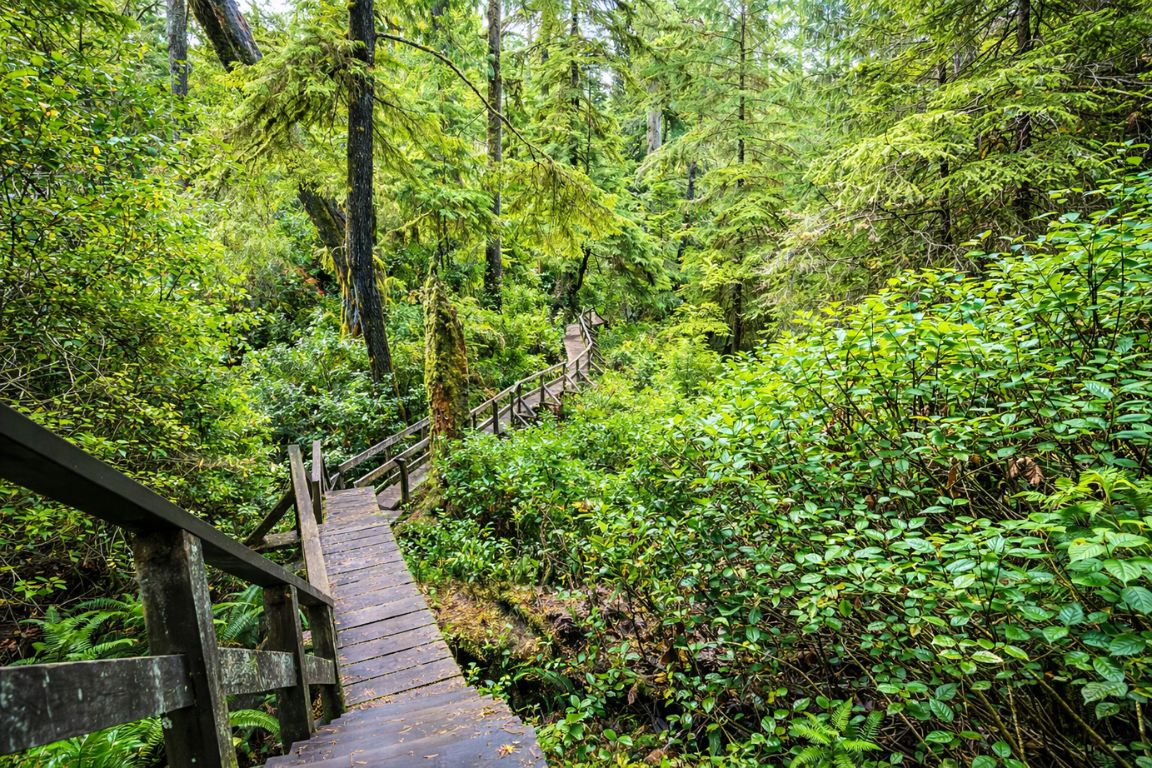 The Rainforest Trail consists of two separate 1.2 km loop boardwalks inside Pacific Rim National Park Reserve, located about 16 km south of Tofino town. Loop A is on the east side of Highway 4, Loop B on the west. Each takes 45 to 60 minutes at a relaxed pace. Both are easy, well-maintained, and genuinely extraordinary. The forest here contains trees confirmed at over 1,400 years old. This is the single best introduction to the Pacific Rim’s temperate rainforest and the right starting trail for any Tofino visit that includes hiking.
The Rainforest Trail is the hike that most people walk for 45 minutes and then spend the next three days recommending to everyone they meet in Tofino. The scale of the trees is not comprehensible until you are standing next to one. Photographs narrow them, compress them, reduce their height to something the eye can calibrate. In person, a western red cedar that has been growing for 1,200 years takes up enough space in your peripheral vision that your body’s sense of proportion simply recalibrates. You become very briefly aware of how long 1,200 years is and how different your own life expectancy is from the thing you are looking at.
Loop A starts on the east side of Highway 4, which means crossing the highway from the main parking lot. The speed limit here is 80 km/h. Cross carefully, with plenty of clearance. Once across, the boardwalk enters the forest within a few steps and the highway sound disappears within the first 100 metres. The interpretive signs on Loop A explain the history and life cycles of the rainforest, covering old-growth succession, nurse logs, and the ecological role of decay. The trail climbs slightly into the forest before looping back.
Loop B starts from the main parking lot on the west side of the highway, making it the more immediately accessible loop. The interpretive signs here focus on the forest ecosystem and its wildlife. Loop B descends deeper into the forest than Loop A and has slightly more stairs in some sections, but both are genuinely easy. Both have sections of moss-covered boardwalk that are slippery when wet, which in a rainforest is most of the time. Grip-soled shoes are the right choice here over smooth-soled trainers.
Do both loops. The combined distance is 2.4 km and takes under two hours at any pace. They are similar in character but not identical, and since you are already in the park and have paid for the day pass, there is no reason to do one and not the other. The parking lot has washrooms. Parks Canada passes are checked at the kiosk.
One detail worth knowing: researchers have found trees in the Tofino area exceeding 1,400 years old and 15 metres in diameter. The coastal temperate rainforest at Pacific Rim is one of the few remaining undisturbed examples of this ecosystem in the world. The Rainforest Trail walks you through the heart of it.
Tonquin Trail: The Town Walk That Finds The Ocean
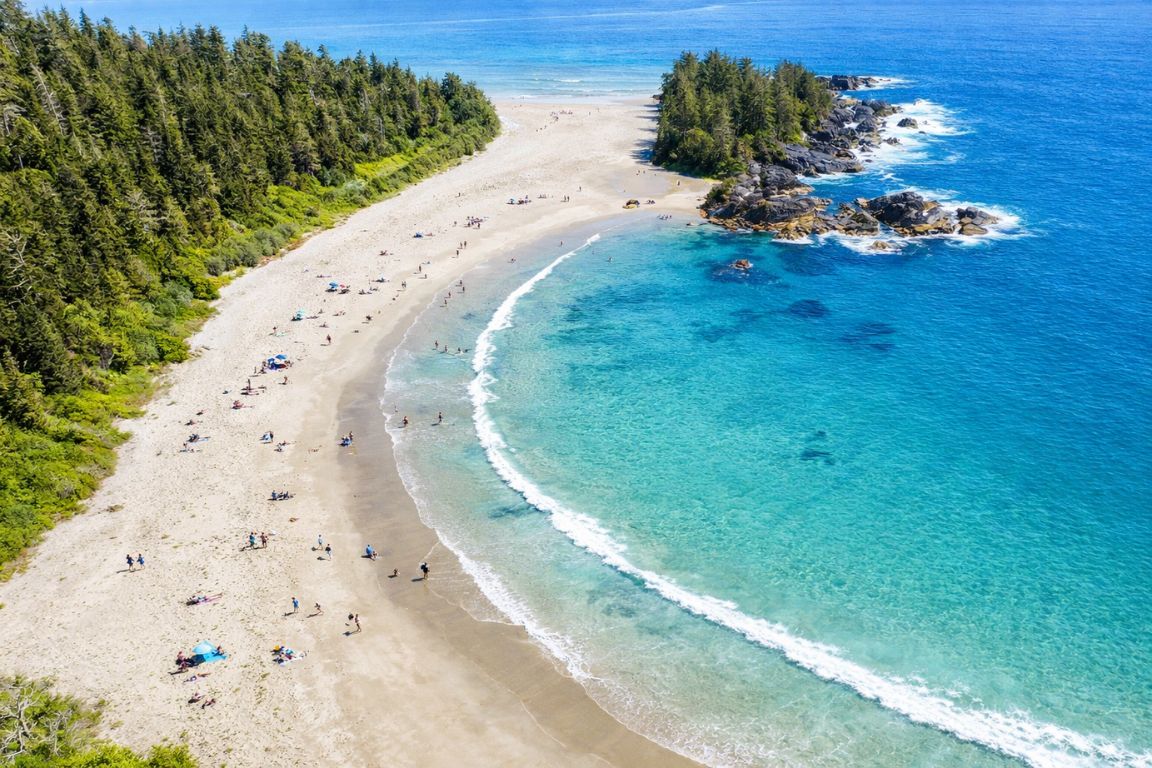 The Tonquin Trail is a 3 km gravel and boardwalk trail that starts from the Tofino Community Hall, less than 1 km from the town centre, and winds through old-growth forest to Tonquin Beach, Third Beach, and Middle Beach. It is free, no park pass required, and walkable directly from any downtown accommodation. The trail includes the Maze Lookout with views over Templar Channel and the site of the historic wreck of the Tonquin, Third Beach as a genuinely secluded pocket discovery, and the full reach of Tonquin Beach bordered by rock formations and sea caves at low tide.
Most Tofino visitors spend their time at Cox Bay, Long Beach, and Chesterman. The Tonquin Trail leads to the beaches those crowds mostly miss. Tonquin Beach is about 800 metres from the Tofino town core by trail, sheltered from the open Pacific by headlands and rock formations that reduce the surf to something gentler than the main surfing beaches. The rock formations along the beach edge form cave-like alcoves at low tide, the kind of features that reward the people who arrive when the water is out and take the time to explore.
We’ve mapped out the best surfing beaches in Tofino tour packages because choosing wrong means fighting crowds at Long Beach when better breaks with fewer people exist just down the road.
The trail begins at the Community Hall (parking available) and can also be accessed from the end of Tonquin Park Road, which saves 800 metres if your only goal is the beach. From the Community Hall trailhead, the gravel path runs through rainforest before descending via wooden stairs to Tonquin Beach. The Maze Lookout, perched above Templar Channel, provides a view of Wickaninnish Island and the area where the American trading vessel Tonquin was blown up in 1811 after a conflict with the Tla-o-qui-aht, the event that gives the trail and beach their name. The history is woven into the landscape here in ways that most visitors do not know to look for.
Third Beach is the smaller and quieter section accessed by continuing south past Tonquin Beach along the trail. It feels like a discovery because it is. It sits in a small embayment, has no parking lot, and appears only to people who have walked far enough to find it. Middle Beach extends the system further south, through the ha-houlthee (traditional territory) of the Tla-o-qui-aht First Nation, with viewpoints of the ocean corridor and the forest edge.
The District of Tofino notes that the full network is 3 km plus 800 m of boardwalk and stairs. The trail has some steep sections and is gravel throughout, with stairs descending to each beach. It is moderately graded rather than flat but poses no challenge to anyone in reasonable walking shape. Dogs are allowed on leash. There are washrooms at the Community Hall and at the Tonquin Beach Road trailhead, but not along the trail itself.
For sunset: Tonquin Beach faces west. On a clear evening, the rock formations catch the last light and the surrounding islands go dark against the sky one by one. It is one of the better sunsets in the Tofino area precisely because fewer people end up here than at Cox Bay or Chesterman.
Meares Island Big Tree Trail: Old Growth By Water Taxi
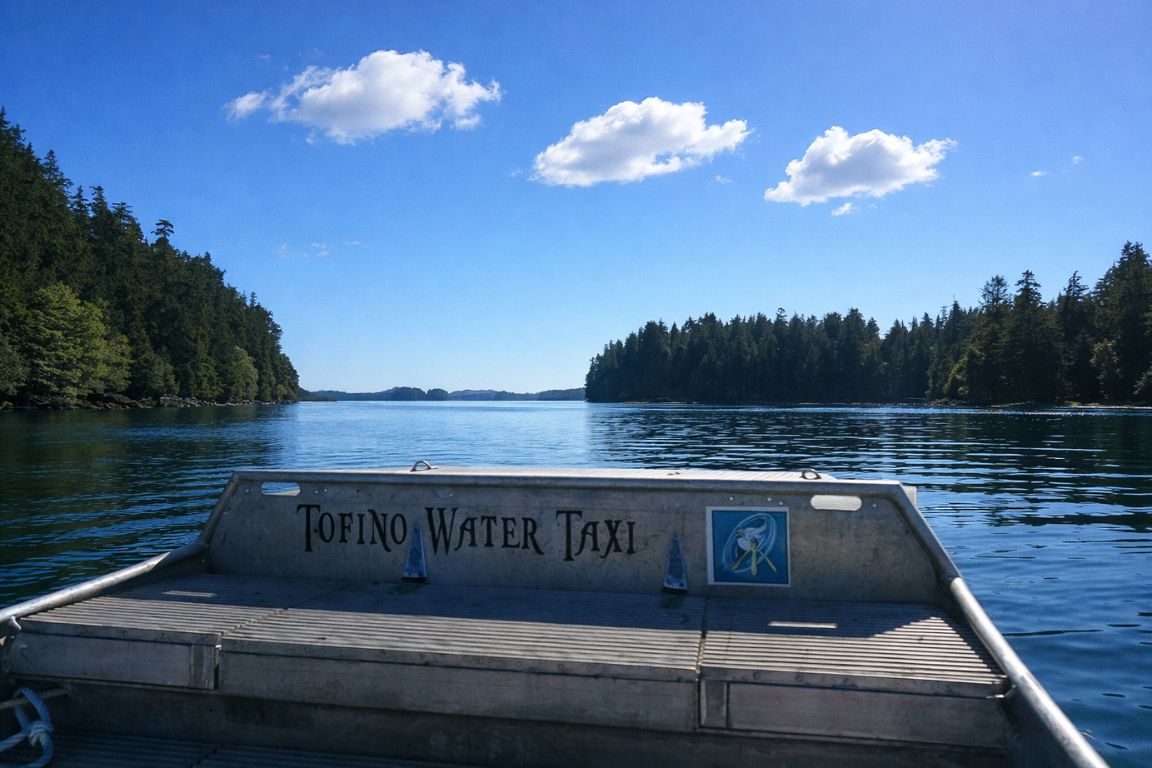 The Big Tree Trail on Wanachus-Hilthuuis (Meares Island) is a 2.4 km out-and-back walk on hand-split cedar boardwalk to the Hanging Garden Tree, a western red cedar estimated at 2,000 years old with a circumference of 18.3 metres. It requires a 10-minute water taxi from Tofino Harbour. The trail fee is $35 adult, $30 youth and senior, $25 child, paid to the Tla-o-qui-aht First Nation who operate the Tribal Park. An extended 4.2 km loop continues past the boardwalk into the forest, with muddy terrain and fallen logs. Most visitors do the boardwalk section only and find it more than sufficient.
You can see Meares Island from the Tofino waterfront. It sits directly across the harbour, close enough that the individual trees are visible from the town dock. What that proximity cannot communicate is what the island looks like when you step off the water taxi landing and move into the forest. The scale shift is immediate. The trees here are old in a way that does not register as statistics. The oldest western red cedars are estimated at 1,500 years. The Hanging Garden Tree at the end of the boardwalk is estimated at 2,000. By the time you reach it, you have been walking through a cathedral for 30 minutes and the final tree is the one that makes the size of every tree before it suddenly seem modest.
The boardwalk is 1.2 km from the water taxi landing to the Hanging Garden, then 1.2 km back. Cedar-planked and hand-split, it rises and falls through the forest on stairs and switchbacks, passing trees at various stages of their 1,500-year life cycles. The interpretive context for the trail includes the 1984 to 1993 War in the Woods: the Tla-o-qui-aht First Nation and Tofino residents blockaded planned logging on Meares Island, an action that became the catalyst for the largest civil disobedience in Canadian history and ultimately protected the forest permanently. The trees you are walking through exist because of that fight.
The full 4.2 km loop goes past the boardwalk’s end and follows a rougher forest trail south along the island, emerging at a beach with views of Clayoquot Sound before looping back. This section is mud, fallen logs to climb over and under, and unmarked terrain that requires more attention and more time. Proper hiking boots are necessary. The boardwalk section can be done in comfortable trainers; the loop section cannot.
Water taxi to Meares Island runs approximately $30 per person return from the Tofino Harbour dock. Call ahead: water taxi operators appreciate pickup pre-coordination. Tofino Water Taxi and Lone Cone Hostel both offer service. Cell reception on Meares Island is inconsistent, so arrange your return pickup before you leave the dock area. The trail fee ($35 adult) is collected at the landing. Children aged 2 and under are free.
Traveling with older family members? I’ve broken down Tofino tour packages for seniors so you know which beaches have accessible boardwalks, what boat tours work for different mobility levels, and which trails avoid steep or muddy sections.
South Beach Trail And Nuu-Chah-Nulth Trail: The Coastal Connectors
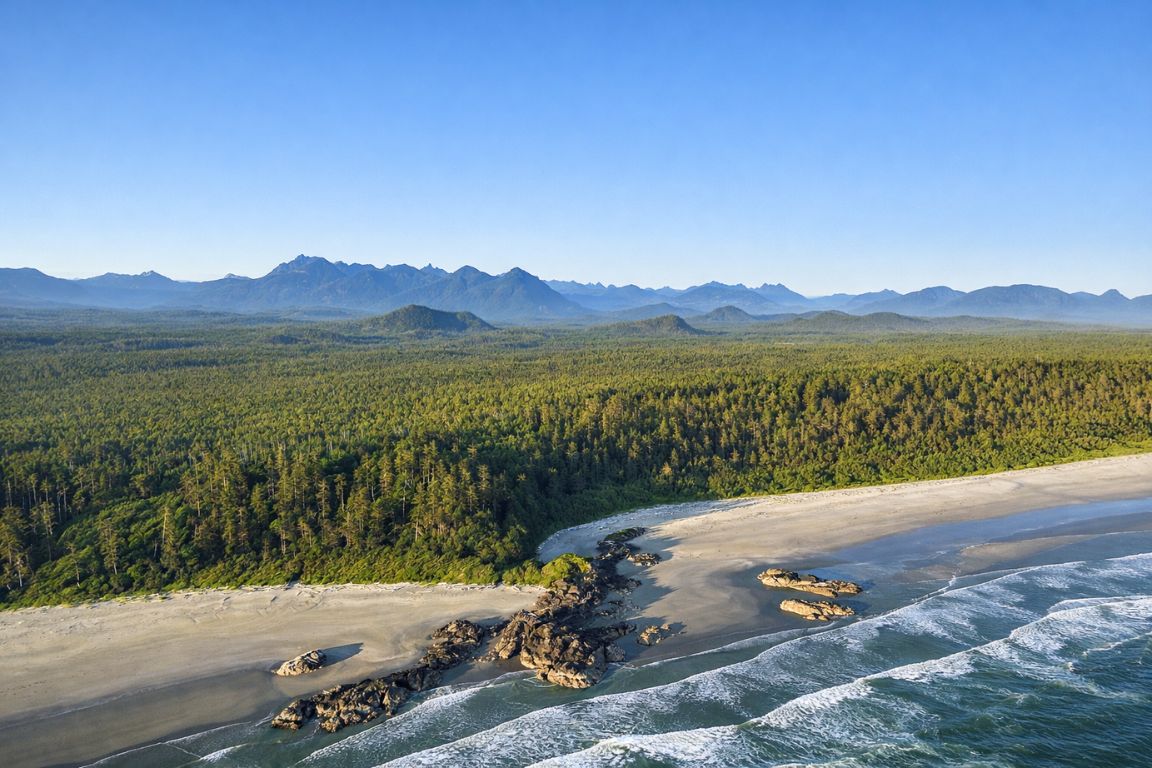 South Beach Trail is a 1.6 km out-and-back trail in Pacific Rim National Park that descends through coastal forest to a dramatic sandy beach with large rock formations and powerful wave activity. It starts behind the Kwisitis Visitor Centre at Wickaninnish Beach. The Nuu-chah-nulth Trail (3.8 km one-way) begins at the same junction and connects through rainforest and bog to Florencia Bay. Together they form the most scenic multi-section hike in the Long Beach Unit of the park, combining coastal views, old-growth forest, and two beaches in a single outing.
South Beach is not Long Beach. It does not have 16 km of sand and a parking lot full of surf schools. It has rock formations that form natural channels and pools, waves that arrive with enough force to generate audible concussions on the rocks, and the particular quality of remoteness that comes from a beach requiring a 1.6 km walk to reach. The rock platform at the water’s edge exposes anemones, sea stars, and crabs at low tide. At high tide, the waves hit the rocks and send spray several metres. The South Beach warning about wave watching is taken seriously: sneaker waves and surge zones are real hazards. Stay back from rock edges and ledges.
The South Beach Trail starts from the parking lot behind the Kwisitis Visitor Centre, following a mix of asphalt, gravel, and boardwalk to several viewpoints before the final descent to the beach via wooden stairs. The views from the headland before the stairs include Lismer Beach and the open Pacific coastline south toward Ucluelet. A totem pole at one of the viewpoints marks the Nuu-chah-nulth trail junction. The surface becomes narrow wooden boardwalk with handrails in the final steep section to the beach. This section is wet and steep enough to warrant care in either direction.
The Nuu-chah-nulth Trail branches left at the junction before the South Beach stairs and runs 2.5 to 3.8 km (sources vary slightly) through rainforest, bog, and coastal terrain to Florencia Bay. This is the longest boardwalk trail in Pacific Rim National Park Reserve and the most culturally rich: interpretive signs cover the Hishuk ish ts’awalk principle (everything is one) of the Nuu-chah-nulth people, the guiding framework for how this land has been understood and cared for across generations. The trail crosses wooden bridges over creeks, passes through bog sections with shorepine and sphagnum moss, and emerges at the Florencia Bay parking lot. Do this trail one-way with a car shuttle at each end, or out-and-back if you want the full length. The terrain is uneven and can be muddy after rain: proper footwear matters here.
The Shorepine Bog Trail, a short (<1 km) wheelchair-accessible boardwalk loop off Wick Road, is worth adding to a day that includes the Nuu-chah-nulth Trail. The bog ecosystem looks nothing like the old-growth cedar-hemlock forest: shorepine trees grow to only a few metres tall after hundreds of years because the acidic, waterlogged soil provides almost no nutrients. Parks Canada describes it as the “broccoli forest” and the comparison is apt. It is one of the more unexpected and memorable environments in the park.
Lone Cone Trail: The Hard One Worth Doing
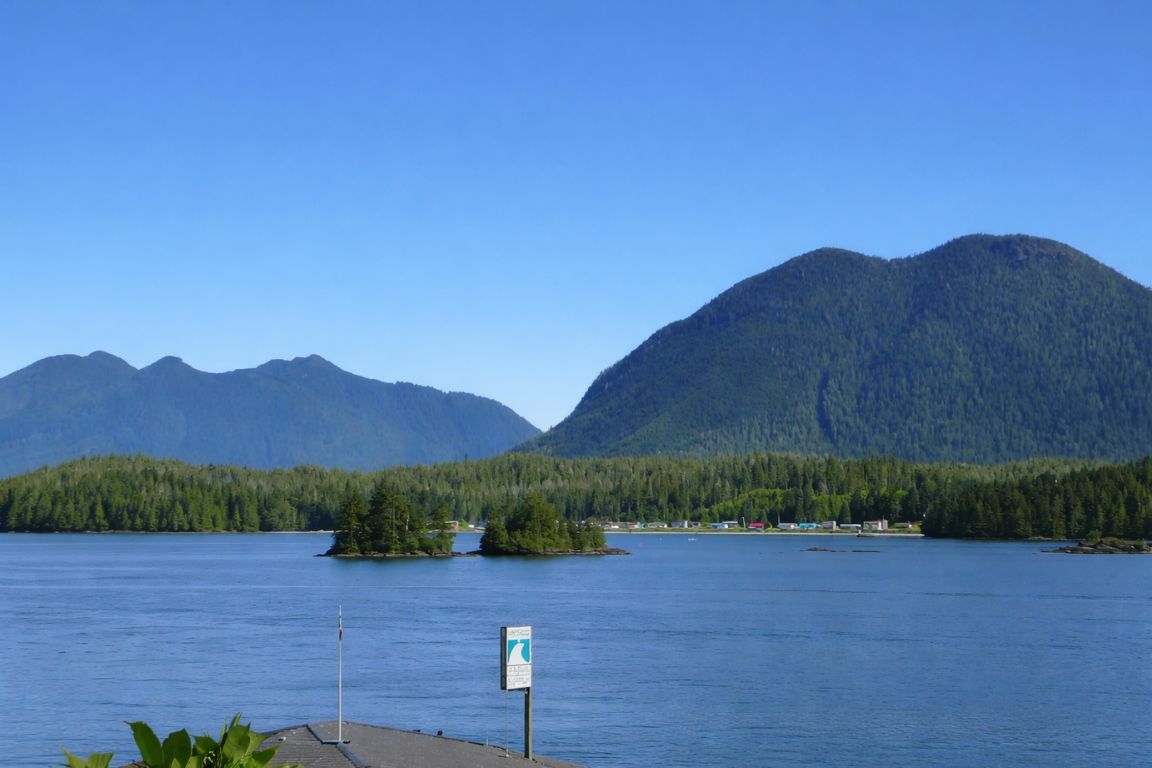 Lone Cone is a 730-metre summit on Meares Island, reached by a 2.7 km trail that gains 700+ metres of elevation over a short, steep distance. The round trip takes 5 to 7 hours. It requires a water taxi from Tofino Harbour and is currently bookable through Ahous Adventures, an Ahousaht Nation-owned company. The trail is challenging and not maintained to the standard of the Big Tree Trail boardwalk. On a clear day, the summit view across Clayoquot Sound, the Pacific, and the Tofino peninsula is unmatched by any other accessible viewpoint in the region.
From the Tofino waterfront, Lone Cone is the mountain that is simply always there. Visible from the harbour, from the beaches, from any elevated point in the town. Its name describes its shape: a single steep cone rising sharply from the forest of Meares Island. Most visitors look at it, note its presence, and do not attempt it. The ones who do come back with photographs that look like they were taken from an aircraft, because the summit is high enough above sea level that the surrounding islands and the Pacific horizon sit below the eye line.
The trail begins with a flat section of roughly one kilometre through dense, muddy forest after the water taxi landing at Kakawis on Meares Island’s west side. This section is deceptive: the terrain is boggy, the footing requires attention, but the grade is manageable. Then the trail gets steep and stays steep. The ascent over the final 1.5 km gains most of the 700+ metres of elevation, which is a very aggressive grade with limited switchbacks. The trail is flagged and marked but not maintained to boardwalk standard. Fallen trees require climbing over or ducking under. The surface is root-bound, muddy, and wet throughout most of the year.
Summit weather on Lone Cone is a specific variable to respect. The summit sits in cloud on many days, and the view that makes the effort worthwhile is the clear-day version. Hiking to the top in low cloud and descending without having seen anything is a real possibility. Check the forecast before booking. A morning departure on a day with forecast clearing is better than an afternoon departure on a day that might close in.
Ahous Adventures, owned and operated by the Ahousaht Nation, is the current operator for guided access to the Lone Cone trail. Their website notes the trail is available for booking through select tourism operators. Check their current status and pricing before planning: the trail access arrangements have evolved in recent years and current availability should be confirmed directly. A water taxi return to Tofino after the hike typically costs approximately $40 to $94 per person depending on the operator and group size.
Who should do this trail: experienced hikers who are comfortable on steep, unmaintained terrain, can read flagged trail markers, and are physically fit enough to sustain effort on a 45-degree slope for 90 minutes of climbing. Hiking poles are strongly recommended on the descent, which is harder than the ascent. Bring more water than you think you need. Register with the operator before starting.
What To Wear And Bring Hiking In Tofino
Tofino hiking gear is determined by one fact: this is a temperate rainforest with roughly 3 metres of annual rainfall and boardwalk surfaces that are slippery when wet, which is almost always. The non-negotiables are grip-soled footwear, a waterproof outer layer, and layers underneath. For the Rainforest and Tonquin trails, trail runners or hiking shoes are adequate. For Meares Island’s full loop, Nuu-chah-nulth, and Lone Cone, proper ankle-supporting waterproof hiking boots are the right choice.
The footwear question is more specific in Tofino than in most hiking destinations because the primary hazard on most trails is wet boardwalk, not technical terrain. Moss-covered cedar planks on a slight incline can be as slippery as ice in the right conditions, and most hiking shoes have adequate grip for dry conditions but less than adequate for wet moss at an angle. Grip-soled rubber is the actual requirement. Trail runners with aggressive lugs, hiking shoes with sticky rubber outsoles, or standard hiking boots all work. Smooth-soled footwear does not.
Layering is the right approach regardless of the forecast. The temperature inside old-growth forest drops 5 to 10 degrees compared to the beach, the humidity is high, and the canopy can drip for hours after rain stops. A moisture-wicking base layer, a light fleece or insulating mid-layer, and a waterproof shell cover all Tofino hiking conditions from April through October. In winter and spring, the shell becomes more important and the insulating layer gets heavier.
What to bring for a half-day trail outing: water (at least 1 litre), a snack, a map or downloaded AllTrails trail (cell signal is unreliable inside the forest), a small daypack to keep hands free, and insect repellent in summer. For Meares Island, add a waterproof dry bag for any electronics and arrange your water taxi return before leaving the dock. For Lone Cone, add hiking poles, significantly more food and water, a rain jacket with hood, and the flexibility to turn around if the summit is in cloud.
One frequently skipped preparation: check the tide table before trails that end at beaches. South Beach floods at high tide and the beach access becomes hazardous. Tonquin Beach’s cave formations are only accessible at low tide. Florencia Bay can flood on high tides. The BC Tides app or Tourism Tofino’s live conditions page shows tide predictions. Planning a beach section of a trail to align with a falling tide gives you the most time before the water returns.
Which Tofino Hiking Trail Is Right For You?
| The best old-growth forest experience with minimal effort | Rainforest Trail A + B | Do both loops; total 2.4 km; Parks Canada pass required |
| A hike from your hotel in Tofino that needs no car | Tonquin Trail | Free; starts at Community Hall; sunset from Tonquin Beach is excellent |
| The most extraordinary individual trees | Big Tree Trail, Meares Island | Water taxi + trail fee; the Hanging Garden Tree is 2,000 years old |
| A coastal hike connecting forest and a dramatic beach | South Beach + Nuu-chah-nulth Trails | Parks Canada pass; Nuu-chah-nulth is best one-way with a car shuttle |
| A genuine challenge with unmatched views | Lone Cone Trail | Book via Ahous Adventures; water taxi required; only fit experienced hikers |
| Something unusual and accessible for the whole family | Shorepine Bog Trail | Under 1 km; wheelchair accessible; completely different ecosystem from the forest trails |
When Is The Best Time To Hike In Tofino?
 The trails around Tofino are open and worthwhile in every season, but the practical window for most visitors is April through October. Summer offers the longest days and most reliable weather. Spring and fall are less crowded and still very hikeable. Winter hiking is real and rewarding for those who come prepared, with the forest at its most atmospherically west coast: mist, dripping canopies, and empty boardwalks. Lone Cone and the full Meares Island loop are better suited to drier months for trail conditions and summit views.
There is a specific quality to hiking in Tofino’s rainforest after rain that does not exist anywhere else. The moss intensifies from green to something luminous. Every fallen log becomes a nurse log nursery with ferns erupting from the bark. The cedar smell is stronger. The light that does get through the canopy filters into something gold-green and diffused. People who hike the Rainforest Trail on a sunny July afternoon have a fine experience. People who hike it on a misty October morning, with fog sitting in the forest and no other visitors in the parking lot, have the experience that this forest was built for.
Summer (June through August) is when the trails are busiest, particularly the Rainforest Trail and Tonquin, which see significant summer tourism traffic. The trails handle this well because they are short and people move through quickly. But if solitude matters, weekday mornings in shoulder season (May, September, October) give you empty boardwalks and the authentic character of the place without the July crowds.
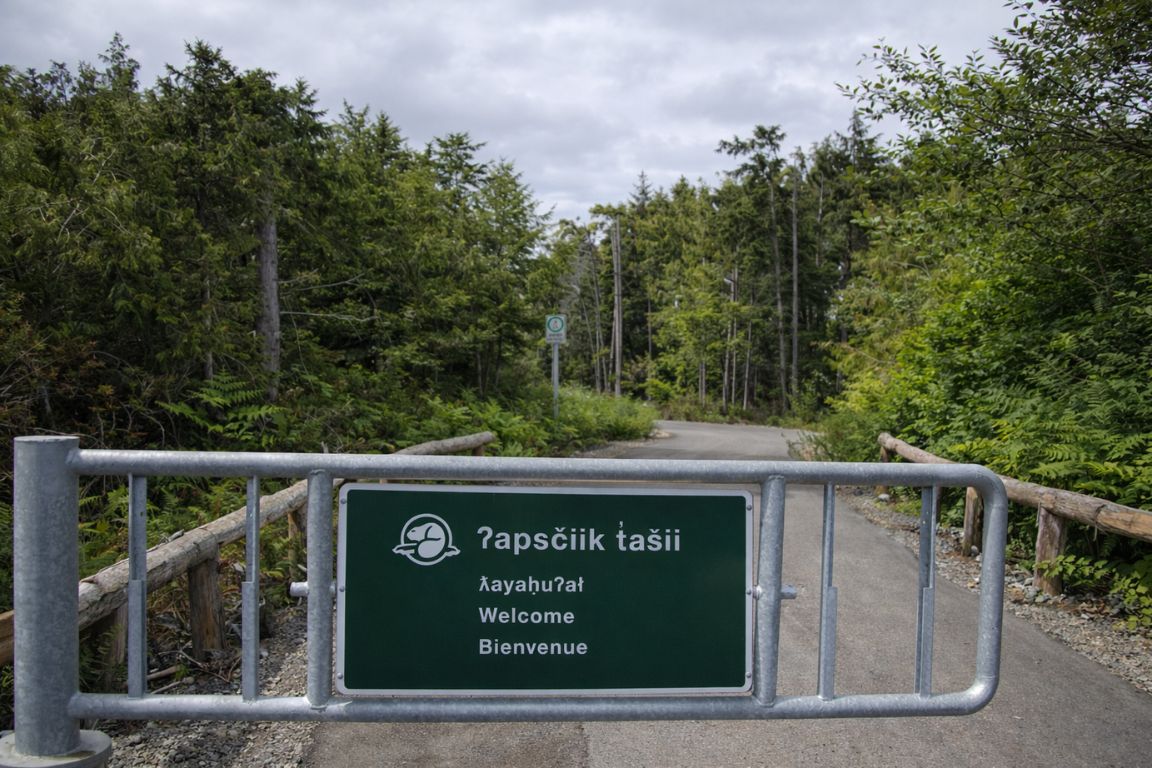
Winter hiking requires preparation and awareness. The ʔapsčiik t̓ašii multi-use path carries a Winter Conditions Warning from Parks Canada: debris, fallen trees, snow, and ice can appear and the path is not maintained in winter. The in-park hiking trails are open but similarly ungroomed. Lone Cone in winter is a serious undertaking and the full Big Tree Trail loop becomes a mud-heavy, log-climbing exercise. The boardwalk-only trails (Rainforest Trail, boardwalk section of Big Tree) remain accessible and enjoyable year-round with appropriate footwear.
Timing completely changes your Tofino experience. The best time to visit Tofino tour packages depends on whether you want dramatic winter storms, summer surfing and whales, or shoulder season rain without the crowds.
What We See From 12,600+ Guests Who Hike In Tofino
After 13 years coordinating Tofino itineraries, the patterns in how guests approach hiking are consistent. The table below captures what we use to recommend the right trail and preparation for different groups.
| Most popular trail among first-time Tofino visitors | Rainforest Trail (Loops A & B) | The trail that consistently surprises guests who didn’t expect hiking to be a Tofino highlight |
| % of guests who hike at least one trail during their stay | 78% | Hiking in Tofino is now nearly as common as beach visits for multi-night guests |
| Most common footwear mistake on the trails | Smooth-soled sneakers/Flip-flops | Smooth-soled shoes on wet boardwalk is the cause of most slips; grip rubber is non-negotiable |
| % who add the Big Tree Trail to their Meares Island kayak trip | 95% | The kayak + Big Tree Trail combination is one of the best half-day combinations in Tofino |
| % who rate Tofino hiking as a trip highlight | 68% | Guests who expect surf and ocean consistently name the forest as the most memorable Tofino element |
The pattern that comes up most consistently across all the hiking guests we have worked with: people who arrive expecting to surf and watch whales and leave having described the Rainforest Trail as the most affecting thing they did in Tofino. The forest here is different from forests they have walked elsewhere. The scale is different. The age is different. The atmosphere is different. It does not translate well in photographs, which means it keeps surprising people who have seen the photographs and thought they knew what to expect.
Frequently Asked Questions
Do you need a permit to hike in Tofino?
For trails inside Pacific Rim National Park Reserve (Rainforest Trail, South Beach Trail, Nuu-chah-nulth Trail, Shorepine Bog Trail), a Parks Canada day pass is required: $10.00 adult, $8.40 senior, free for youth, $20.00 family. Passes are purchased at automated kiosks in the parking lots. The Tonquin Trail is managed by the District of Tofino and is free. The Big Tree Trail on Meares Island charges a separate trail fee ($35 adult) paid to the Tla-o-qui-aht First Nation. Lone Cone is bookable through Ahous Adventures with a water taxi fee.
What is the easiest hike in Tofino?
The Rainforest Trail Loops A and B are the easiest: 1.2 km each on maintained boardwalk, 45 to 60 minutes per loop, with minimal elevation gain. The Shorepine Bog Trail is even shorter and wheelchair accessible. Both are inside Pacific Rim National Park and require a day pass. The Tonquin Trail is also easy and free, though it has some stairs and moderate terrain compared to the boardwalk loops.
Is there hiking in Tofino that does not require a car?
Yes. The Tonquin Trail starts from the Tofino Community Hall, less than 1 km from downtown, and is fully walkable from any accommodation in the town core. The Meares Island Big Tree Trail requires a 10-minute water taxi from Tofino Harbour (not a car). The Rainforest Trail and the park trails require a car or transportation to the Pacific Rim National Park parking lots, about 16 km south of town, though they are accessible via West Coast Transit and the ʔapsčiik t̓ašii bike path.
What is the best hike in Tofino for families?
The Rainforest Trail is best for families with young children: short, flat boardwalk, extraordinary scenery, and no technical terrain. The Big Tree Trail boardwalk section on Meares Island is also very family-friendly, though it requires a water taxi which adds planning. The Tonquin Trail suits older children who can manage gravel trail and stairs. Lone Cone and the full Big Tree loop are not appropriate for young children.
How do I get to the Rainforest Trail from Tofino?
Drive south from Tofino town on Highway 4 into Pacific Rim National Park Reserve. Watch for the signed Rainforest Trail parking lot on the right (west side of the highway), approximately 16 km from Tofino. The parking lot has washrooms and a kiosk for Parks Canada passes. Loop B starts from the parking lot. Loop A requires crossing the highway to the east side. Cyclists can reach the trailhead via the ʔapsčiik t̓ašii multi-use path. West Coast Transit bus stops near the Rainforest Trail junction on Highway 4.
How hard is Lone Cone trail?
Lone Cone is a challenging trail that climbs over 700 metres in approximately 2.7 km, making it one of the steepest accessible hiking routes in the Tofino area. The trail is not maintained to boardwalk standard, involves muddy terrain, root scrambling, fallen logs, and limited switchbacks on the steepest sections. AllTrails rates it as challenging. It is only appropriate for fit, experienced hikers with proper waterproof boots and hiking poles. The round trip takes 5 to 7 hours. Book via Ahous Adventures and check current access arrangements before planning.
Written by Ethan James Callahan
Canadian tour guide since 2012 · Founder, Tofino Tour Packages
Ethan has guided over 12,600 travelers through Tofino and the surrounding Pacific Rim wilderness since founding the agency.