Where To Eat And Drink In Tofino
Tofino feeds about 2,500 residents and a summer crowd many times that size out of a handful of kitchens at the end of one highway. Here is what is worth booking, what you can walk up to, where the beer and the gin are actually made, and how far ahead the good seats go.
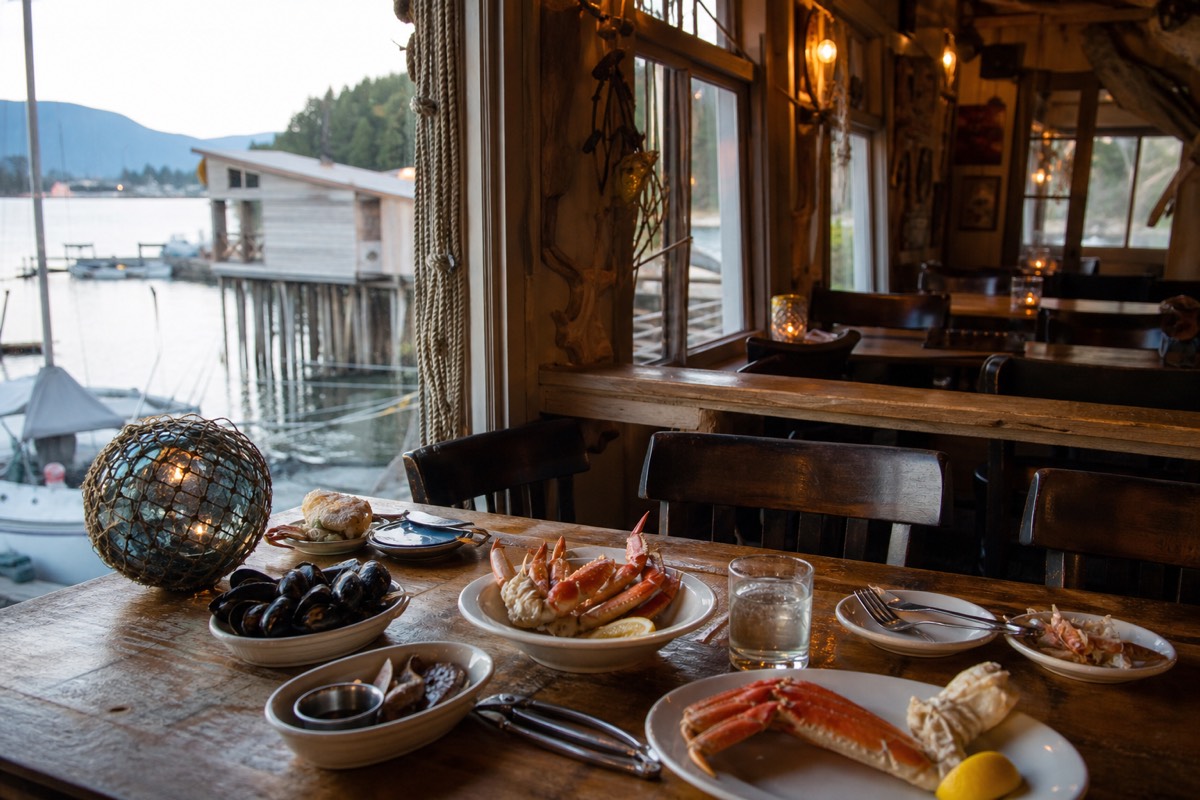
The 2021 census counted 2,516 people living in Tofino. In August the town holds many times that, and almost all of them want to eat between six and eight in the evening, in a place with one road in and a kitchen count you could list on a napkin. That arithmetic, not the cooking, is what trips people up. The cooking is genuinely good. The seats are genuinely scarce.
This guide splits the town's eating into the four things you actually have to decide between: the rooms you book weeks out, the counters and trucks you walk up to, the taproom and tasting room on Industrial Way, and the morning coffee and bakery run. It also names the two places that have closed since most Tofino lists were written, because driving five hours to a locked door is a particular kind of disappointment. Addresses and hours below come from each business's own published information.
What four days of eating here costs
Food allowances are the same figures used in our four-day Tofino trip budget for two people in peak summer, presented as planning ranges rather than menu prices. Addresses, hours and beer and spirit names come from each business's own published information.
Restaurant tables and brewery visits remain separate from the tour choices. The verified food-related outing is private crabbing with a forest walk and included lunch.
Affiliate links: we may earn a commission from qualifying bookings.
Where Should You Book A Table In Tofino?
Four kitchens carry most of the town's evening bookings: Wolf in the Fog on Fourth Street, The Pointe at the Wickaninnish Inn on Chesterman Beach, Shelter at the Tofino Resort and Marina, and The Schooner on Campbell Street. Reserve those weeks ahead for July and August. Almost everything else in town is walk-up territory.
Wolf in the Fog sits at 150 Fourth Street and has been the town's best-known kitchen since Air Canada's enRoute magazine named it the best new restaurant in Canada in 2014. The menu leans on what the coast produces: fish landed locally, wild greens and mushrooms foraged nearby, produce from Vancouver Island growers. Service runs daily from 5 pm. The house takes reservations for parties of up to six and its own site says walk-ins are always welcome, which is true and also slightly misleading in the last week of July, when welcome means a name on a list and an hour on the sidewalk.
The Pointe at the Wickaninnish Inn is the other end of the scale, and a different kind of evening entirely. It sits on the rock headland at 500 Osprey Lane on North Chesterman Beach with a 240-degree window on the open Pacific, and it serves either a three-course table d'hote or a five-course tasting menu rather than an a la carte list. It is a Relais and Chateaux room. People who stay at the inn book it with their room; people who do not should call well ahead on 250-725-3106 rather than assume.
Shelter is the most forgiving of the four, because its service window is enormous. Its own site and the Tourism Tofino listing both place it at 634 Campbell Street beside the Tofino Resort and Marina, open daily from 7:30 am to 11:00 pm, with inlet views and a fireside patio. Local wild-caught seafood is the spine of the menu. If your day on the water runs long and you need somewhere that will still feed you at half past nine, this is usually the answer.
The Schooner at 331 Campbell Street has been feeding this town for more than seventy years, longer than the highway has been paved the whole way. Steak, seafood and cocktails, in the town core, without the reservation arms race attached to the newer names. It is the room locals send visiting relatives to.
| Room | Where | What it is | Service | How hard to get in, July to August |
|---|---|---|---|---|
| Wolf in the Fog | 150 Fourth Street | West Coast cooking on foraged and locally landed ingredients; named Canada's best new restaurant by enRoute in 2014 | Daily from 5 pm | Reserves parties up to six; walk-ins accepted but expect a real wait |
| The Pointe at the Wickaninnish Inn | 500 Osprey Lane, North Chesterman Beach | Set-menu fine dining, 240-degree ocean view, Relais and Chateaux | Three-course table d'hote or five-course tasting menu | The hardest seat in town; book with your room or call weeks out |
| Shelter | 634 Campbell Street, at the Tofino Resort and Marina | Wild-caught local seafood, cocktails, fireside patio over the inlet | Daily 7:30 am to 11:00 pm | Reserve, but the long window means late seats exist |
| The Schooner | 331 Campbell Street | Seventy-plus years of steak, seafood and cocktails in the town core | Check current hours | Steady rather than frantic; the town's institution |
Read that last column as the real difference between these four. They are not ranked by quality, because quality here is a matter of what you feel like. They are ranked by how much planning each one costs you.
What Does Eating In Tofino Actually Cost?
Two people spending four days here should allow roughly $200 to $300 if they cook most meals and eat out casually, or $400 to $600 for a mix of takeaway lunches and booked tables. That works out to about $25 to $38 per person per day at the low end and $50 to $75 at the mid range, before any tasting-menu night.
Those are the food lines from the trip budget we already publish for a four-day summer stay, and they hold up because the shape of eating here is unusually predictable. There is no cheap late-night strip. There is a small number of counters that are genuinely good value, a small number of rooms that are not cheap anywhere, and a grocery store. What moves your food bill is how many evenings you hand over to a kitchen.
The thing that surprises visitors is that the gap between a food-truck lunch and a booked dinner is wider here than in a city, because the casual end is cheaper than you expect and the top end is priced like a destination room. A truck lunch for two and a coffee run is a small number. An evening at a set-menu room with wine is not. There is very little in between, so the sensible plan is to pick your nights rather than drift.
| Approach | Four days, two people | Roughly per person per day | What that actually buys |
|---|---|---|---|
| Cook most meals, one night out | $200 to $300 | $25 to $38 | Groceries, a truck lunch or two, one casual sit-down evening |
| Mix of casual and booked tables | $400 to $600 | $50 to $75 | Coffee out, takeaway lunches, a reserved table two or three nights |
| Add one set-menu evening | Add that night on top of either line | Not comparable | A multi-course room prices on its own logic; check the current menu before you commit |
| Camping and self-catering | Below the low line | Lowest | Cooler, firepit, groceries, one meal out for the experience of it |
Treat those as planning allowances rather than quotes. They are what we budget for guests, not a price list, and no kitchen here has agreed to them. The tasting-menu line is deliberately blank because a set menu changes with the season and quoting a number that goes stale helps nobody.
How Far Ahead Do You Need To Book A Table?
In July and August, book the four sit-down rooms two to four weeks out, at the same time you lock your accommodation. In June and September a week is usually enough. From November to February most nights are walk-in, but check hours first, because winter service shrinks and some kitchens close for a stretch.
The booking rhythm here follows accommodation, not the other way round. Our own planning guidance is to reserve a room three to four months ahead for July and August, and six to eight weeks in shoulder season. Tables lag that by a couple of months but move the same way, and the pattern we see repeatedly is that people book the room in March, book the whale watching in June, and think about dinner on the drive over. That is the trip where you end up in the truck line, which is not a punishment, but it should be a choice.
One quirk worth planning around: because the town's kitchens are small, a single sold-out night can push an entire group's plans sideways. If you are travelling with more than six people you are effectively outside the reservation system at Wolf in the Fog, which caps reservations at six. Split into two tables at different times, or point the group at somewhere with a bigger room and a longer service window.
| What you are booking | July to August | June and September | November to February |
|---|---|---|---|
| Accommodation | 3 to 4 months | 6 to 8 weeks | Days, often same-week |
| Set-menu evening at a destination room | Book with your room | 2 to 3 weeks | A few days; confirm the room is open |
| Sit-down table for two | 2 to 4 weeks | About a week | Walk-in most nights |
| Table for a group over six | Assume you are splitting the group | 2 weeks, split if needed | Call ahead anyway |
| Boat tours and wildlife trips | 4 to 6 weeks | 2 to 3 weeks | Fewer departures; check the schedule |
| Trucks, taproom, bakery | No booking, just timing | No booking | Check seasonal hours |
If a specific evening matters to you, book it before you book the boat. Boats have several departures a day. A twenty-seat room has one shot at seven o'clock.
Where Do You Eat Well Without Booking Anything?
The walk-up scene is centred on the Outside Break plaza at 1180 to 1184 Pacific Rim Highway, on the way into town. The original Tacofino food truck has been parked behind the surf shop there since 2009, Wildside Grill is a few doors along, and Chocolate Tofino is in the same cluster. None of them take reservations and none of them need to.
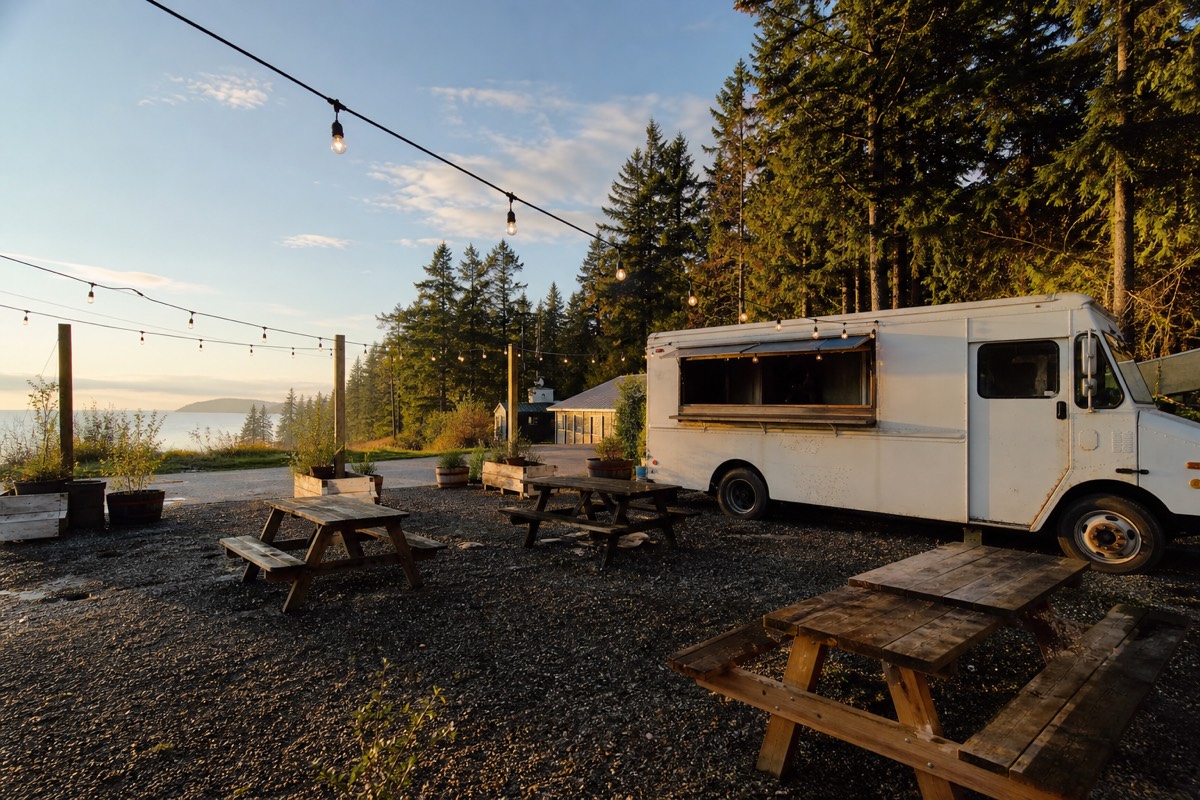
Tacofino started life in 2009 as one truck in the back of that parking lot and turned into a chain across British Columbia without ever closing the original. It is still at 1184 Pacific Rim Highway, behind the Live to Surf shop, and it is still the thing people photograph. There is now a second, larger Tofino location at 450 Campbell Street in town if the truck line looks grim or the weather has turned genuinely hostile.
Wildside Grill at 1180 Pacific Rim Highway is the one locals name when a visitor asks where to get fish and chips without pretending it is a special occasion. It was started by a commercial fisherman, Jeff Mikus, and a chef, Jesse Blake, which is a lineage you can taste, and it runs daily from 11 am to 8 pm. Chocolate Tofino sits at 1180A in the same plaza, making handmade chocolates and gelato since 2003, and functions as the reliable bribe at the end of a cold beach walk.
There is a second cluster of walk-up food out at the brewery on Industrial Way, where Toki Doki runs Japanese street food out of an Airstream and Adriana's does focaccia sandwiches. That combination, a taproom bench and a truck window, is the most reliably pleasant cheap evening in Tofino and requires no forward planning at all.
| Counter | Where | What it does | Hours |
|---|---|---|---|
| Tacofino, original truck | 1184 Pacific Rim Highway, behind Live to Surf | The 2009 original; tacos and burritos from a truck in a surf-shop car park | Seasonal truck hours; check before a late run |
| Tacofino, town location | 450 Campbell Street | Larger indoor and outdoor sibling in the town core | Longer season than the truck |
| Wildside Grill | 1180 Pacific Rim Highway, Outside Break plaza | Fish and chips and grill counter from a fisherman-and-chef partnership | Daily 11 am to 8 pm |
| Chocolate Tofino | 1180A Pacific Rim Highway | Handcrafted chocolate and artisan gelato, making since 2003 | Check current hours before a late run |
| Toki Doki Airstream | On site at the brewery, Industrial Way | Japanese street food beside the taproom benches | Tied to taproom hours |
| Adriana's | On site at the brewery, Industrial Way | Focaccia sandwiches | Tied to taproom hours |
All of these sit on the highway rather than in the walkable core, which matters if you arrived without a vehicle. Our guide to getting around Tofino without a car covers the shuttle and the bike path that make the Outside Break cluster reachable in summer.
Does Tofino Have A Brewery And A Distillery?
Yes, and they are next door to each other on Industrial Way. Tofino Brewing Co. has been brewing at 691 Industrial Way since April 2011 and runs a taproom daily from noon, with no reservations. Tofino Distillery is at 681 Industrial Way, units G and H, with a tasting room open from noon to 7 pm.
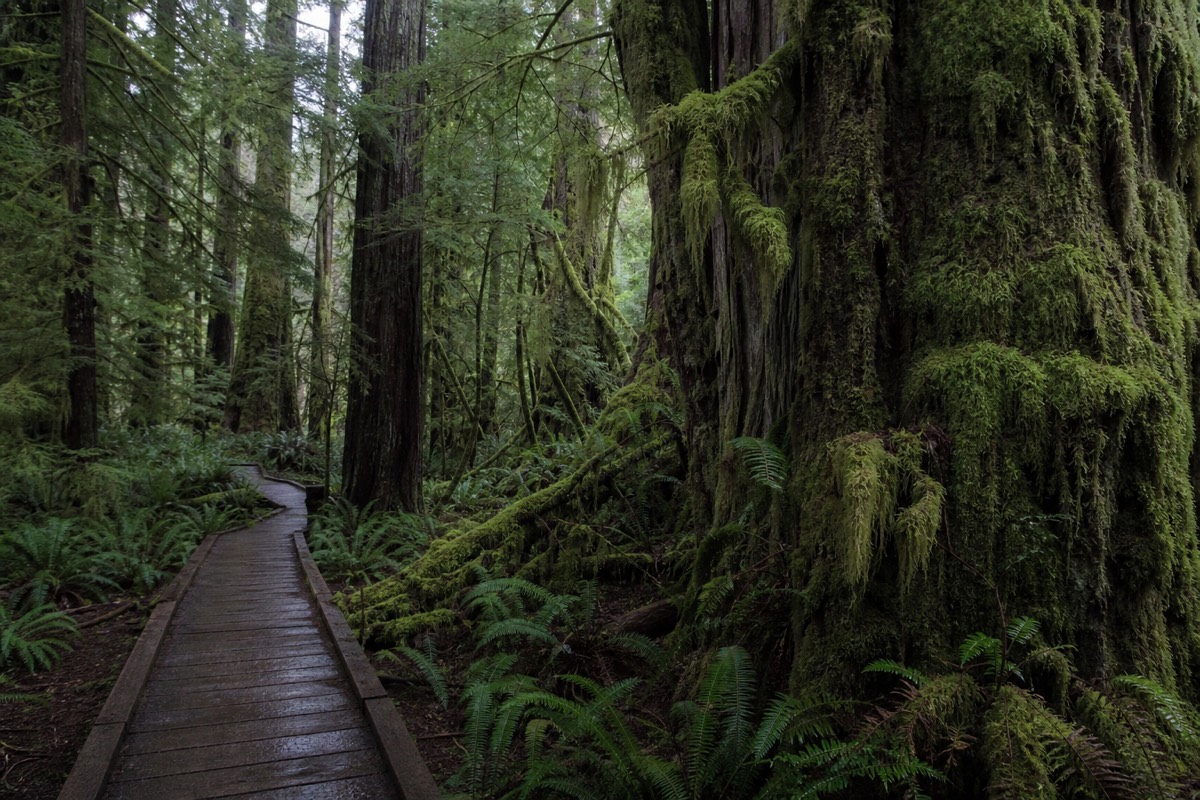
The brewery is the more famous of the two and the more sociable. The taproom is open noon to 9 pm Sunday through Thursday and noon to 10 pm on Friday and Saturday, with a patio, a large indoor bench space and the two food trucks parked on site. You do not book. You turn up, and in August you share a table.
The beer that people come for is the Kelp Stout, brewed with local kelp, which sounds like a gimmick and is not. The rest of the core list runs Tofino Lager, a blonde ale, Tuff Session Ale, Ethereal IPA, Cosmic Wave Double IPA and a Bohemian-style pilsner, alongside rotating small-batch pours that change with what the brewhouse is doing that month. You can read the current list on the brewery's own site before you go.
Next door, Tofino Distillery works from organic BC grain and organic botanicals, and holds PACS organic certification 16-884. The two gins worth trying are the Old Growth Cedar Gin and the West Coast Gin, both built on local botanicals; there are also lavender mint and rose hibiscus gins, vodkas including jalapeno and espresso versions, absinthe, limoncello and whisky. The tasting room does mini-cocktail flights rather than full pours, which is the sensible format when you have to drive back to your campground afterwards. No reservation needed there either.
| Producer | Address | Tasting room | What to try | Reservations |
|---|---|---|---|---|
| Tofino Brewing Co. | 691 Industrial Way | Noon to 9 pm Sunday to Thursday; noon to 10 pm Friday and Saturday | Kelp Stout, brewed with local kelp; Tuff Session Ale; rotating small batches | None taken, none needed |
| Tofino Distillery | 681 Industrial Way, units G and H | Noon to 7 pm | Old Growth Cedar Gin, West Coast Gin, mini-cocktail flights | None taken |
| Toki Doki (at the brewery) | 691 Industrial Way | With taproom hours | Japanese street food from an Airstream | Walk up |
| Adriana's (at the brewery) | 691 Industrial Way | With taproom hours | Focaccia sandwiches | Walk up |
Industrial Way is exactly what it sounds like, a working light-industrial street rather than a scenic one, and that is part of the charm. Nobody built this strip for visitors. It is where the town's own beer and gin get made, and the benches happen to be open to you.
Where Do You Get Coffee, Bread And Something Sweet?
Rhino Coffee House on Campbell Street covers the town-core morning with espresso, donuts and breakfast wraps. Tofino Coffee Roasting Company roasts at 605 Gibson Street. Common Loaf Bake Shop at 180 First Street has been baking here since the 1970s. Chocolate Tofino handles the sweet end out on the highway.
Coffee here is a genuine local industry rather than a hotel amenity, which is one of the small pleasures of the place. Tofino Coffee Roasting Company roasts on site at 605 Gibson Street and runs a cafe alongside it, so what you drink was almost certainly roasted within a few hundred metres of the cup. Rhino Coffee House is the one most visitors end up in because it sits in the walkable town core on Campbell Street, opens early, and does actual breakfast rather than just pastries.
Common Loaf Bake Shop at 180 First Street is the oldest thread in the town's food story. It has been a whole-food bakery since the 1970s, before the surf boom, before the highway got busy, and it is still where you buy a loaf and a cinnamon bun to take to the beach. Wandering in on a wet Tuesday morning in February and finding it warm and full is one of those experiences that explains why people move here.
If you are camping or self-catering, the bakery-and-roastery run is also the practical solution to breakfast, because cooking eggs in the rain at a walk-in site loses its appeal on day three. Our team at Tofino Tour Packages books guests onto boats rather than into dining rooms, but the question we field most often before a 7 am departure is where to get a coffee first, and the answer is almost always the town core.
| Stop | Where | Best for | Note |
|---|---|---|---|
| Rhino Coffee House | Campbell Street, town core | Espresso, matcha, donuts, breakfast wraps and sandwiches | The walkable option if you are staying in town |
| Tofino Coffee Roasting Company | 605 Gibson Street | Coffee roasted on site; beans to take home | Cafe and roastery in one |
| Common Loaf Bake Shop | 180 First Street | Bread, buns, whole-food baking since the 1970s | The town's oldest food business still going |
| Chocolate Tofino | 1180A Pacific Rim Highway | Handmade chocolate and gelato since 2003 | Out on the highway, in the Outside Break cluster |
Which Tofino Places Have Closed, And Why It Matters Here
Jeju, the Korean kitchen on Fourth Street, has closed; its own website now says so and points readers to Vancouver. Kuma Tofino is also permanently closed. Both still appear on plenty of Tofino lists, including an older planning page on this site, because most restaurant round-ups are never revisited after publication.
This matters more in Tofino than it would in a city. If a place has closed in Vancouver you walk two blocks. Here, a closed door can mean a twenty-minute drive back along the highway with a hungry car, at the exact hour when everywhere else has stopped seating. The town's food roster also turns over faster than its reputation does, partly because staff housing in a protected coastal corridor is brutally scarce and partly because a seasonal economy is hard on small kitchens.
Our own guidance on how to plan a trip to Tofino still lists Jeju among the town's must-book names, which was accurate when that page was written and is not accurate now. We would rather say that plainly than quietly delete it, because the useful lesson is the general one: check the current status of any specific room before you build an evening around it, especially outside July and August. A quick look at the business's own site or social feed takes thirty seconds and is worth more than any list, this one included.
The flip side is that the walk-up layer is stable. The original truck has been in the same car park since 2009, the bakery since the 1970s, the brewery since 2011, and the steakhouse for seventy years. If you want certainty rather than novelty, that is where it lives.
How Do You Eat Well While Camping Or Self-Catering?
Buy groceries in town, cook on the firepit if your site has one, and plan one meal out rather than several. Private campgrounds near Tofino provide firepits and sell firewood on site. If you are heading into the backcountry, note that there is no potable water in the Broken Group Islands, so food planning becomes water planning.
Self-catering is the single biggest lever on a Tofino food budget, and it is what takes a four-day trip for two from the $400 to $600 band down toward $200 to $300. It also suits the rhythm of the place. Days here get eaten by tides and weather windows, and a cooler in the car means you are not hostage to whether the kitchen you wanted is seating at the hour you are finally hungry.
Firepit cooking is genuinely part of the appeal at the private sites on Mackenzie Beach and Cox Bay, where fire rings and firewood are standard. Our full breakdown of camping in Tofino goes campground by campground on what each one actually provides, including which ones take tents at all. The one thing to plan around is that the good beach sites are booked out months ahead in summer, which puts your food plan downstream of a reservation you should already have made.
One genuinely fun option sits between cooking and eating out: the private crabbing trip that runs from the Marine Adventure Centre drops traps in Tofino Inlet and lets you keep the catch, provided everyone aged sixteen or over holds a valid BC tidal waters sport fishing licence. That is the only meal in this guide you cook yourself and still get a boat ride out of.
What Is Actually Local On A Tofino Menu?
Fish landed on this coast, wild greens and mushrooms foraged nearby, crab out of the inlet, kelp in the stout, and organic BC grain in the gin. The local claim here is unusually literal, because the supply chain is short and the sea is at the end of the street.
Wolf in the Fog builds its menu around exactly that combination, and describes it that way itself: seafood from Tofino suppliers, meat and grain from Vancouver Island farmers, wild greens and mushrooms picked from the forests and shorelines around town. Shelter makes the same commitment in a plainer register, leading on local wild-caught seafood. The Pointe frames it as West Coast terroir and puts it in a set menu that changes with what is available.
The drinks side is where the sourcing gets genuinely unusual. Kelp Stout uses kelp harvested locally, which is not something you can order in most of the country. The distillery works from organic BC grain and organic botanicals under a certified organic programme, and its cedar gin leans on a tree that grows in the rainforest twenty minutes up the road.
The honest caveat is that local does not mean everything on every plate. This is a small town at the end of a long supply route, and a great deal still arrives by truck across the island. What is genuinely from here is the seafood, the foraging, the beer and the spirits, and those are the things to order if provenance is what you came for.
A Three-Night Eating Plan That Actually Works
Book one destination evening, keep one evening flexible for whatever the weather does, spend one at the taproom, and put your effort into breakfast rather than lunch. Lunch in Tofino should be portable, because the best hours of a good day are the ones you are outside for.
The failure pattern we see is people booking three evenings, then discovering that the tide, the boat schedule and a two-hour rainstorm have rearranged the whole day and they are now sprinting to a seven o'clock reservation with wet hair. Three fixed dinners in a town this weather-dependent is one too many. Two is right, and one of those should be flexible.
The plan below assumes a summer stay with a car and one boat trip. Shift the taproom evening to whichever day you are coldest and wettest, because a bench indoors beside a truck window is the correct response to a bad forecast.
| Day | Morning | Middle of the day | Evening |
|---|---|---|---|
| Arrival day | Coffee and a loaf from the bakery on your way in | Truck lunch at the Outside Break plaza | Walk-in at the Campbell Street steakhouse, no pressure on a travel day |
| Full day one | Early espresso in the town core before a boat departure | Portable food; you are on the water or the trails | The evening you reserved weeks ago; leave a full hour of margin |
| Full day two | Bakery run, eat on the beach | Fish and chips counter on the highway | Taproom bench, food truck window, no booking, no clock |
| Departure day | Coffee and beans to take home from the roastery | Chocolate or gelato stop as you leave town | Eat in Port Alberni or Nanaimo on the drive back |
That plan costs one reservation, made early, and nothing else. It also survives contact with a west coast forecast, which the three-reservation version does not.
Who Should Skip The Reservations Game Entirely?
Anyone travelling in winter, anyone with a group over six, anyone camping, and anyone whose days are being dictated by tides and boat departures. The walk-up layer here is strong enough that you can eat well for a week without booking a single thing.
Winter is the obvious case. From November to February the town thins out, some rooms close for a stretch, and the tables that stay open are not fighting for space. The correct winter approach is to check who is actually open that week and then turn up. Storm-watching season rewards spontaneity in a way that August does not.
Groups are the second case, and the arithmetic is unforgiving. Wolf in the Fog caps reservations at six. A group of ten in Tofino in August is not going to sit down together at short notice anywhere good, so either split the group and eat at two times, or lean entirely on the counters, the taproom and a rented kitchen. The latter is usually the happier trip.
The third case is people whose schedule belongs to something else. If you have a 7 am departure, a mid-afternoon low tide you want to walk, and a bear-watching trip that goes out in the evening light, a seven o'clock table is a liability rather than a treat. Eat around the coast, not around the clock. The town is small enough that missing one famous room is not the loss it would be somewhere else, and the fish and chips counter on the highway has fed more happy visitors than any tasting menu ever will.